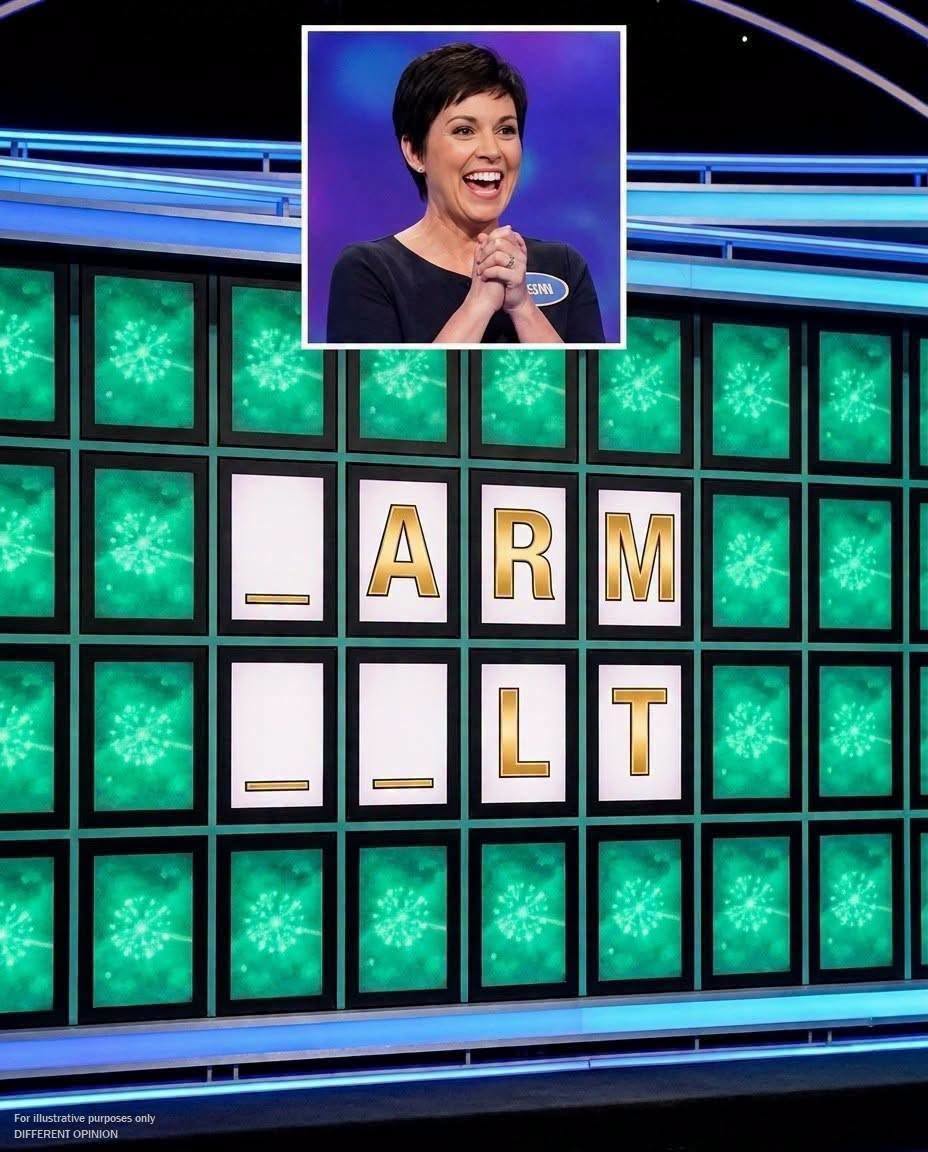
The atmosphere inside the studio felt unusually tense before the contestant had even taken her place. Bright lights covered the stage, the audience watched closely, and a countdown created the kind of pressure that often causes people to second-guess answers they would recognize immediately at home.
Other contestants had struggled under the same conditions. They searched for letters, whispered possibilities, and visibly reacted as time disappeared. Every second encouraged faster thinking, but speed often produced more confusion. The puzzle seemed to become harder the longer people stared at it.
Then one contestant responded in a completely different way. She did not appear to chase combinations or work through a long list of possibilities. Her eyes shifted, her focus changed, and she seemed to step mentally away from the noise around her.
Without a long buildup, she gave her answer. It was correct.
The solution reportedly secured $65,000, but the amount was only part of what made the moment memorable. Viewers were stunned by how quickly she solved the puzzle and by the absence of visible struggle. The answer seemed to arrive fully formed, as though she had recognized it rather than calculated it.
Footage of the moment circulated widely. People replayed the recording and examined the available angles, trying to understand what she noticed. Watching again did not provide a simple explanation. She had not traced letters in the air, written possible answers, or announced a sequence of guesses.
That apparent effortlessness became the central mystery. Audiences are accustomed to seeing achievement presented as visible work: concentration, false starts, corrections, and a final breakthrough. Her stillness disrupted that familiar pattern. The difficult problem appeared to become simple before anyone else understood why.
Some observers attributed the solution to intuition. Others argued that experience with word patterns allowed her brain to recognize the phrase before conscious reasoning caught up. Puzzle solving often involves both processes. A person may absorb common structures over years, then identify a pattern in seconds without being able to describe every mental step.
The countdown may also have helped rather than harmed her. Pressure overwhelms many people, but it can sometimes narrow attention and push away irrelevant possibilities. Instead of trying to force an answer, she may have allowed the visible information to settle until the complete phrase emerged.
Her body language added to the fascination. She looked calm while the room around her carried the emotional weight of the moment. That contrast made the answer seem even more dramatic. When someone appears uncertain and then succeeds, the audience shares the relief. When someone appears almost detached and succeeds instantly, the audience experiences surprise.
The reaction was not simply admiration for winning money. It reflected a deeper fascination with moments when human perception seems to move faster than explanation. Everyone has experienced a smaller version: recognizing a face immediately, completing a familiar lyric, or finding a word before consciously searching for it.
The contestant displayed that phenomenon under studio lights, with thousands of dollars attached to the result. Her answer turned a private mental flash into public entertainment.
Analysts could discuss probability, training, vocabulary, and pattern recognition, but viewers responded to the emotional simplicity of the scene. There was a puzzle that appeared difficult, a room full of people expecting hesitation, and one person who saw the solution.
The recording became compelling because repetition did not make the moment feel ordinary. Even after viewers knew the answer, they remained interested in the speed of recognition. The result seemed obvious only after she had said it.
That is one of the strange qualities of puzzles: the distance between confusion and clarity can be extremely small. For several seconds, the available pieces appear disconnected. Then one detail changes the interpretation of everything else, and the answer becomes impossible not to see.
Her win captured that exact transition. The maze did not gradually become easier. It disappeared at once.
The $65,000 prize gave the moment a clear outcome, but the calm solution is what people remembered. In a setting designed to create visible pressure, she demonstrated the power of stepping back from noise. Whether the answer came from intuition, preparation, pattern recognition, or a combination of all three, she found it before the studio had time to understand what was happening.