The scent of gardenias was heavy in the air, a fragrance that should have signaled a new beginning. Instead, for me, it felt like the culmination of a long, exhausting battle. At fifty-seven, I had already walked through the fire. I had held my husband Daniel’s hand as cancer stole his breath, and then, in a cruel twist of fate, I had faced the same diagnosis myself just months later. I survived, but the victory was pyrrhic. The medical bills had devoured our life savings, leaving me with a clean bill of health but a mountain of debt that felt heavier than the illness ever had.
When my daughter Lydia announced her engagement to Grant, my heart soared and then immediately sank. I couldn’t give her the wedding she dreamed of. I couldn’t even afford the flowers. That was the opening Vanessa had been waiting for.
Vanessa, Grant’s mother, was a woman who navigated life through the checkbooks of the men she’d married. She was polished, perpetually smiling, and possessed a heart made of cold, hard flint. She stepped in to fund the wedding, but it wasn’t an act of charity; it was a hostile takeover. I remember her standing in Lydia’s kitchen, her eyes scanning our modest life with visible disdain. She made it clear that because she held the purse strings, she held the crown. She dictated the venue, the guest list, and the rhythm of the day, effectively erasing me from my own daughter’s milestone. Grant tried to intervene, but Vanessa silenced him with a sharp reminder of who was paying the bills. For Lydia’s sake, I swallowed my pride and retreated into the shadows.
The day of the wedding arrived with a deceptive brilliance. The sun was high, and the venue—a sprawling estate Vanessa had chosen to showcase her wealth—was undeniably beautiful. Lydia looked like a vision of resilience as she held her bouquet, her eyes fixed on the future. We shared a quiet moment of peace, a brief reprieve from the storm, until the arrival of the limousine shattered the atmosphere.
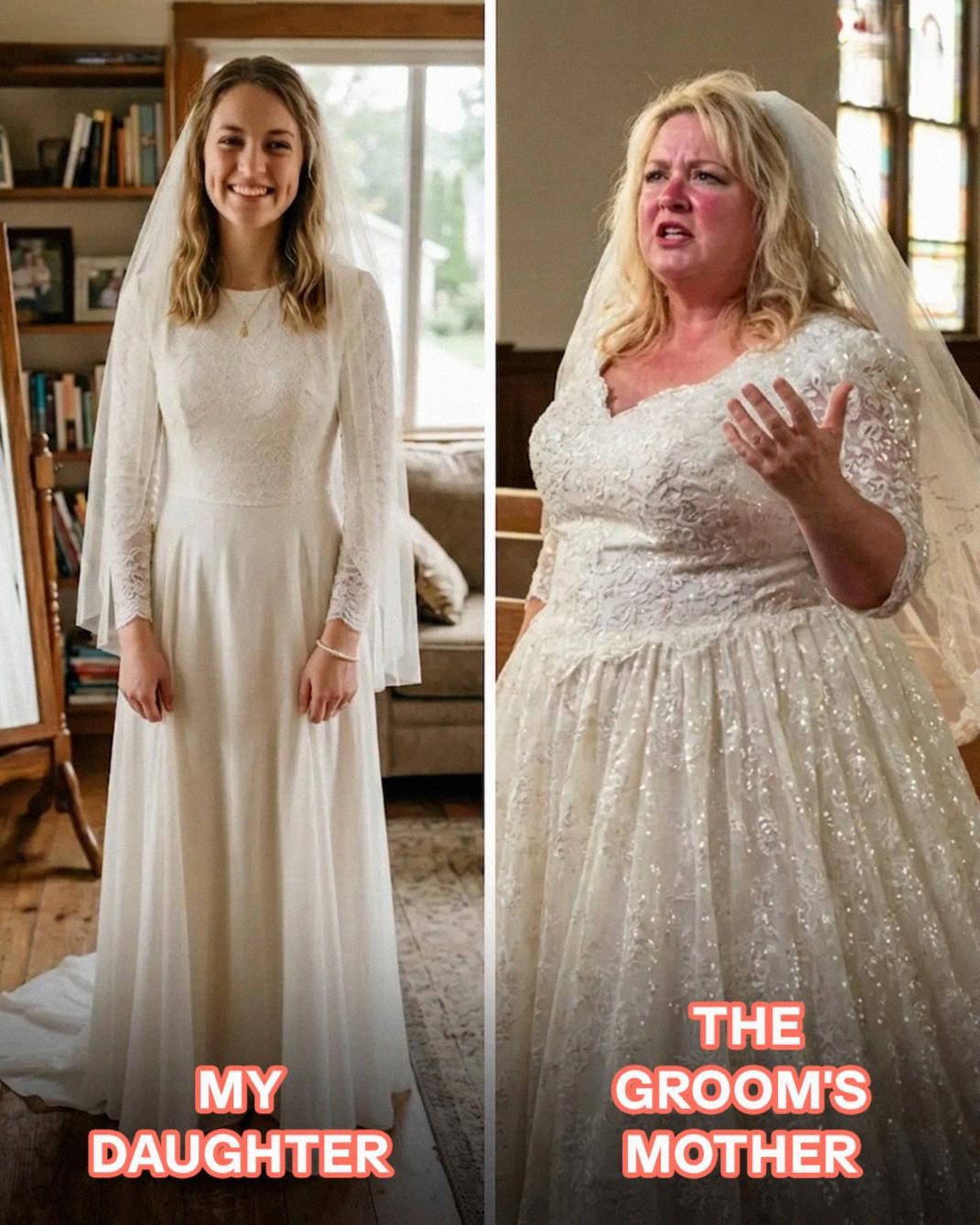
When the door opened, the gasps from the guests were audible. Vanessa stepped out, not in a tasteful mother-of-the-groom ensemble, but in a full-length, intricate white lace gown complete with a trailing veil. It was a blatant, calculated declaration of war. She wasn’t just attending a wedding; she was attempting to be the bride. The audacity of it left the air thin. I watched the light die in Lydia’s eyes, replaced by a hollow kind of heartbreak. Vanessa swept past us, her chin tilted high, remarking that “someone had to look like the star.”
I felt a primal surge of protective rage, the kind that makes your vision blur. I was ready to cause a scene that would be whispered about for decades. But then, I caught the eye of Caleb, the photographer. He was a young man with a quiet intensity, and he gave me a look—a sharp, knowing glance that wordlessly told me to hold my ground. Trusting an instinct I couldn’t explain, I stepped back.
As the ceremony began, Vanessa’s behavior shifted from vanity to sabotage. She didn’t just sit in the front row; she hovered. Every time Caleb raised his camera to capture a tender look between Lydia and Grant, Vanessa would glide into the frame, adjusting her veil or repositioning herself to ensure she was the focal point of every memory being captured. She was physically manifesting her control, turning my daughter’s wedding into a photoshoot for her own ego.
Then, the air was filled with a low, mechanical hum.
At first, the guests looked around in confusion, thinking perhaps a swarm of bees had been disturbed. But the sound was rhythmic and precise. Caleb’s drone, which had been circling high above for aerial shots, began to descend. It didn’t drop toward the altar; it drifted toward the back of the aisle where Vanessa was currently posing for a self-appointed “candid” shot.
The drone hovered just inches behind her head. Before anyone could process what was happening, the spinning propellers caught the fine, delicate lace of her long white veil. There was a sudden, sharp tug. Vanessa’s head snapped back as the drone, programmed with a new and very specific flight path, began to ascend.
With the grace of a rising kite, the veil was lifted clean off her head. Vanessa shrieked, reaching upward as her carefully pinned hair began to unravel, but the drone was faster. It drifted backward, the long white lace streaming behind it like a captured ghost. The drone rose toward an ancient, gnarled oak tree bordering the aisle and expertly maneuvered until the lace became hopelessly snagged on a high, sturdy branch.
The silence that followed lasted only a heartbeat. Then, a single giggle broke through, followed by a wave of laughter that crashed over the entire guest list. It was a release of all the tension Vanessa had spent months building. People were clutching their sides, wiping tears from their eyes as they watched the “Queen” of the wedding frantically jumping beneath the tree, her expensive heels sinking into the soft turf, trying in vain to reach her stolen crown.
Vanessa lost her composure entirely. She was no longer the polished socialite; she was a woman shouting at a tree while her white gown became stained with grass and dirt. In her desperation to retrieve the veil, she managed to snag her dress on the trunk, creating a jagged tear that ruined the silhouette she had worked so hard to curate.
And then, the best sound of all: Lydia laughed.
It wasn’t a mean-spirited laugh, but a genuine, soul-cleansing release. She looked at Grant, who was grinning ear to ear, and the two of them shared a moment of pure, unadulterated joy that Vanessa couldn’t buy or break. The spell of the white dress was shattered. Vanessa was no longer the star; she was the comic relief.
The rest of the ceremony proceeded with a renewed energy. Vanessa eventually managed to yank her veil down, but it was shredded and gray with dust. Defeated and exposed, she retreated. She didn’t try to photobomb another picture. By the time the reception started, the woman who had tried to own the day had slipped away to the parking lot, realizing that while she had paid for the flowers and the food, she had completely lost the room.
Later that evening, I found Caleb packing his gear. I thanked him, not just for the photos, but for the “adjustment” he had made to the afternoon’s events. He gave me a modest shrug and told me that sometimes, a photographer’s job is to make sure the right people are in focus.
As I watched Lydia and Grant dance under the string lights, barefoot and glowing, I realized I had learned something vital. Vanessa had been terrified of being invisible, so she tried to eclipse everyone else. But true presence isn’t about the color of your dress or the size of your bank account. It’s about the moments that happen when you stop trying to control the world and simply start living in it. I went home that night and, for the first time in years, I didn’t think about the debt or the cancer or the things I had lost. I thought about the laughter under the oak tree, and I finally let the weight of the past go.