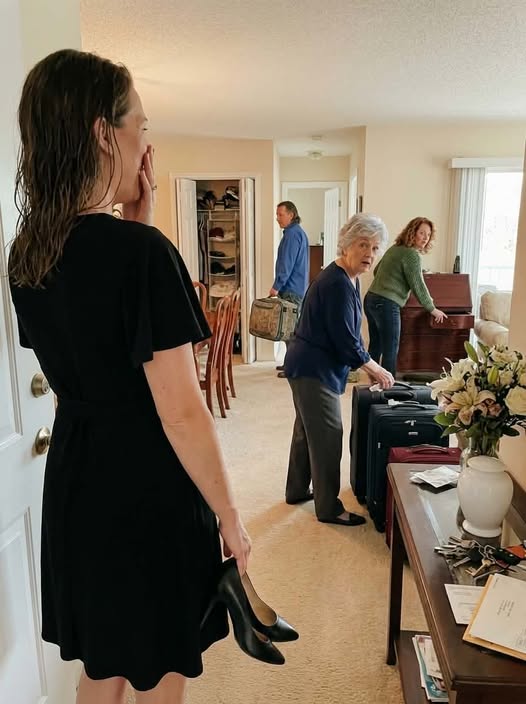
The black silk of my dress felt like a second, colder skin as I turned the key in the lock. I expected to be met by a wall of silence—the heavy, hollow kind that follows a funeral, where the only thing left to do is exist in the space someone else used to occupy. I wanted to sit in the dark and let the scent of lilies finally fade from my senses. Instead, the moment the door swung open, I was hit by the frantic sounds of a ransacking.
The living room, once our sanctuary of quiet books and shared coffee, looked like a staging ground for a heist. My mother-in-law, Marjorie Hale, stood in the center of the room like a general overseeing a raid. Eight of Bradley’s relatives were stripping the apartment of its life. Suitcases were splayed across the floor. Hangers shrieked against the metal rods of the coat closet. Two cousins were already stacking boxes of Bradley’s vintage records in the hallway, moving with the efficiency of professional movers rather than grieving family.
On our mahogany dining table, a handwritten list sat beside the bowl where we used to drop our keys. It was Marjorie’s handwriting—sharp, aggressive, and entitled. It was a catalog of our lives, categorized by what she deemed hers. Nearby, Bradley’s temporary urn sat untouched in its velvet box, a heartbreakingly small vessel for a man who had meant everything to me, now surrounded by people who viewed his death as a clearance sale.
Marjorie turned when she heard me. She didn’t look guilty; she didn’t even have the decency to startle. She simply tilted her chin upward with that expression of high-born patience she used whenever she found my presence inconvenient. She told me I was back, as if I were a guest who had overstayed a welcome in my own home. When I asked what she was doing, her voice was cold and certain. She told me the house was theirs now, and everything Bradley owned belonged to the family. She told me I needed to leave.
I watched Fiona, his sister, rifling through his desk drawers. I watched Declan, a cousin who had spent his life chasing bad investments with other people’s money, zipping up Bradley’s leather travel bags. They didn’t look at me. To them, I was already a ghost, an obstacle that had been removed the moment Bradley’s heart stopped beating. When I asked who had let them in, Marjorie held up a brass key with a smirk. It was the copy Bradley thought he had secured months ago. She viewed that piece of metal as a deed of ownership.
Fiona yanked at a locked drawer, her frustration mounting. She turned to me with a look of pure venom, calling me nothing but a widow. In her mind, that word meant I was powerless. But as I looked at their greedy, hurried movements, a sudden, sharp realization washed over me. I didn’t cry. I didn’t scream. Instead, I laughed. It was a clear, ringing sound that cut through the noise of the looting.
Marjorie asked if I had lost my mind. I told her no—I had simply realized that they were making the same mistake they had made for nearly forty years. They assumed that because Bradley was a quiet man, he was a weak one. They assumed that because he didn’t flaunt his success, he hadn’t achieved any. To his family, Bradley was the “difficult” son who moved away and stopped answering their demands for money. They had no idea who he really was.
They didn’t know that Bradley was an expert in historical asset recovery and forensic accounting. He spent his career tracing the very kind of greed currently on display in my living room. He knew how people hid money, and more importantly, he knew how they stole it. He had spent years building a fortress of trusts and LLCs specifically designed to keep people like Marjorie at bay.
Six days before he died, in the sterile light of the ICU, Bradley had predicted this exact moment. He had told me they would come as collectors, not family. He told me to call Elena, his attorney, and most importantly, he told me to laugh. He had spent his final hours ensuring that the one person who loved him for his soul, and not his bank account, would be protected.
The laughter died down as a firm knock echoed through the room. I opened the door to find Elena Cruz, Bradley’s sharp-witted attorney, accompanied by the building manager and a county deputy. The atmosphere in the room curdled instantly. Elena didn’t waste time with pleasantries. She informed the room that the residence was under legal protection and that the trust Bradley created held all occupancy rights.
Marjorie tried to bluster, claiming the apartment was family property, but Elena was a wall of stone. She produced the recorded deeds and the revocation of all prior access. When Fiona screamed that there was no will, Elena countered with a truth that silenced them: there was nothing left to probate because Bradley had moved everything into a private trust. He had defeated them with the very structure they were too arrogant to ever investigate.
Then came the final blow. Elena pulled out a black folder containing surveillance stills. Bradley had installed interior cameras weeks ago when he suspected his mother had been entering the home while he was at work. The photos showed Declan’s hands in Bradley’s files and Marjorie using her illicit key. The room went silent. It wasn’t just a legal defeat; it was a total exposure of their character.
The deputy began the process of clearing the room. Luis, the manager, watched as every suitcase was reopened. Bradley’s shirts were put back on their hangers. His watches were returned to their tray. His documents were reclaimed. As Marjorie reached the door, she tried one last time to intimidate me, asking if I thought I was safe. I told her that Bradley had made me safe—this moment had simply made her visible.
After they were gone, and the heavy silence finally returned, Elena handed me a flash drive. I sat at the dining table and watched Bradley’s final message. His face was pale on the screen, but his eyes were bright with a protective fire. He apologized for the ugliness I had to witness but reminded me that peace requires boundaries. He officially declared that his mother and cousins had no authority over his life or his legacy.
He left them each exactly one dollar in a separate instruction, a legal “no-contest” clause that ensured if they ever tried to sue for more, they would trigger the release of evidence regarding their past financial frauds. He had handled them with the precision of a surgeon.
I sat in the quiet condo as the Florida sun began to set, looking at the urn and the fresh flowers I had placed beside it. My husband was gone, but his love remained a shield around me. They had come to strip his life bare, but they had left with nothing but a single dollar and the knowledge that the man they underestimated had seen through them all along. I was no longer just a widow; I was the guardian of the peace he had worked a lifetime to build.