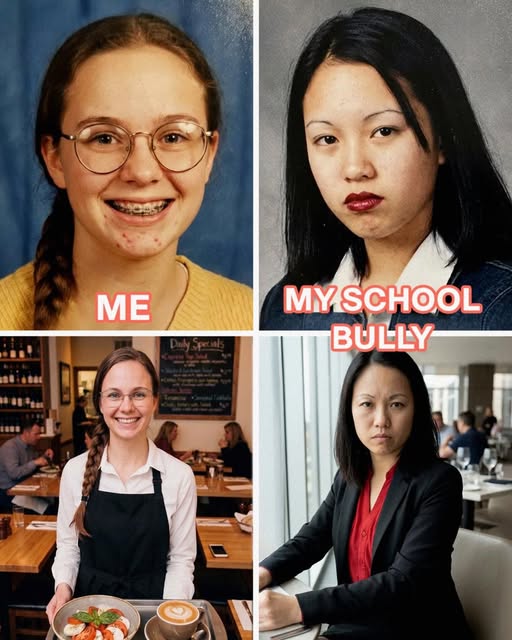
In the hierarchical ecosystem of high school, Madison was a predator who thrived on the perceived weaknesses of others. She possessed a beauty that was as sharp as her tongue and a family bank account that she used as a shield against any form of accountability. To the casual observer, she was the golden girl of our graduating class, but to those of us who lived in her shadow, she was a nightmare in designer clothing. She spent four years systematically dismantling my self-esteem, mocking the secondhand sweaters my mother found at thrift stores and the discounted shoes that were a necessity rather than a choice. She took a cruel delight in the fact that my mother worked three separate, exhausting jobs just to keep a roof over our heads. I survived those years by perfecting the art of invisibility, keeping my head down and counting the seconds until graduation would grant me an escape from her surgical precision. I believed that once I crossed that stage with my diploma, Madison would become a fading ghost of a difficult past. I didn’t realize that life has a cruel habit of bringing you face-to-face with the people you thought you had outrun.
Twelve years later, the world looked very different. I had worked my way into a stable, quiet career as an analyst for a logistics firm. It was a job defined by spreadsheets and deadlines, providing exactly the kind of predictable security I craved after a chaotic childhood. However, that stability was shattered when my mother received a diagnosis of stage three cancer. The medical system is a voracious beast, and soon my modest salary was being swallowed whole by the costs of chemotherapy, specialized scans, and the mounting pile of medications required to keep her alive. Without hesitation, I traded my pride for a second job. Three nights a week, I donned an apron and worked the late shift at an upscale downtown restaurant. I didn’t care about the long hours or the aching in my feet; every table I cleared was a step toward my mother’s recovery. If waitressing meant she got another round of life-saving treatment, I would have worked until my hands bled.
The collision occurred on a humid Thursday evening while I was wiping down a table in my section. My mind was occupied with the frantic mental math of upcoming rent and insurance premiums when a sound cut through the ambient noise of the restaurant—a laugh that was sharp, artificial, and instantly recognizable. I looked up and felt the air leave my lungs. There, seated at table fourteen, was Madison. She looked exactly as I expected: expensive, wrapped in a cream-colored wool coat, with hair styled into effortless waves and a look of supreme boredom that she wore like a crown. The recognition didn’t happen all at once. It moved through her in stages: first, a flicker of confusion, then a slow, predatory realization. She had found her favorite old toy, and I could see the delight sparking in her eyes.
Madison didn’t bother looking at the menu I placed before her. Instead, she leaned back and stared at my name tag, her smile broadening into something cold and jagged. She began a loud, performative commentary on my career path, making sure her dining companion and the surrounding tables could hear every word. She asked if I had finally reached the pinnacle of my potential by fetching drinks for people like her. I kept my voice as neutral as possible, offering the standard choices of sparkling or still water, but Madison wasn’t there for the food. She was there for the spectacle. She moved the conversation to my mother, asking with mock concern if she was still “toiling away” at those sad little jobs. When I told her firmly to leave my mother out of her mouth, she let out a high, melodic laugh and called me “touchy.”
The cruelty reached a breaking point when I delivered her appetizer. With a deliberate, slow motion of her hand, Madison tipped her water glass. Ice and water flooded across the white linen and directly into her own lap. She didn’t flinch. She simply stared at me with a smirk and reminded me that since I was “the help,” it was my job to clean up the mess she had created. As I knelt on the floor, my hands shaking with a mixture of volcanic rage and sheer exhaustion, she leaned down and whispered that some things never change—that I was destined to spend my life cleaning up after people who actually mattered.
I was on the verge of losing my job by speaking my mind when a firm, steady hand settled on my shoulder. A tall, well-dressed man in a tailored suit stepped into the light. I recognized him immediately; he had been part of a high-level executive group dining in the back booth. Madison’s face turned an ashen shade of grey, and she gasped out the name “Ethan.” This was the man she was intended to marry, the wealthy pillar of the community she had spent months bragging about on social media. Ethan’s jaw was set in a hard, uncompromising line. He looked at the spilled water, the napkins in my hand, and then finally at his fiancée. He told her in a voice that was dangerously quiet that he had been standing at the bar, and he had heard every single word of her tirade.
Madison immediately tried to pivot, spinning a frantic narrative that we were just “old friends” engaging in “high school banter.” She accused me of being dramatic and tried to reach for Ethan’s hand, but he pulled away as if her touch was toxic. He looked at her with the eyes of a man seeing a complete stranger for the first time. He asked her directly if she had truly mocked a woman’s sick mother and created a physical mess just to humiliate someone who was working. When Madison scoffed and told him to stop acting like this was a tragedy, the silence that followed was heavy enough to crush the room. Ethan reached into his pocket and produced a small, velvet ring box. He spoke with a heartbreaking clarity, telling her that he had spent two years falling in love with a woman he thought was kind and full of integrity. He realized now that he had been in love with a mask.
He placed the ring box on the damp tablecloth, right in the center of the puddle she had made, and told her the engagement was over. Madison spiraled into a visible panic, her carefully curated persona disintegrating into a fit of screaming accusations. She blamed me for ruining her life, calling me a “bitter waitress” who had sabotaged her future. But Ethan didn’t look back. He told her that he wasn’t ending things because of the waitress; he was ending things because of who Madison was at her core when she thought no one important was watching. For the first time in her life, Madison lost control of the room. I simply picked up my tray and told her that I hadn’t made a scene—I had simply come to work.
I retreated to the kitchen, my heart hammering against my ribs. Later that night, Ethan found me in the alleyway as I was finishing my shift. He offered a sincere, shaken apology for the behavior I had been subjected to. He admitted he was grateful to have seen the truth before he committed his life to a lie. He handed me a significant amount of cash, far more than the bill or a standard tip, insisting that it was for the mess and the trouble. I accepted it with a quiet thank you, my mind immediately going to the cost of the next round of chemotherapy.
When I returned home, my mother was awake, nestled under a mountain of blankets. I sat on the edge of her bed and told her everything. I told her about the water, the humiliation, and the moment the girl from high school finally met a consequence she couldn’t charm her way out of. My mother cried, not for the money, but because she wished she could have shielded me from that kind of cruelty years ago. I told her that she had already given me the only thing that mattered: a safe harbor and a reason to keep fighting. Madison had expensive shoes and a cold heart, but she was now more alone than I had ever been. I was still a waitress, and the bills were still waiting, but as I sat with my mother, I knew I had won. I was still standing, I was loved, and for the first time in twelve years, I was finally free of the girl who tried to break me.