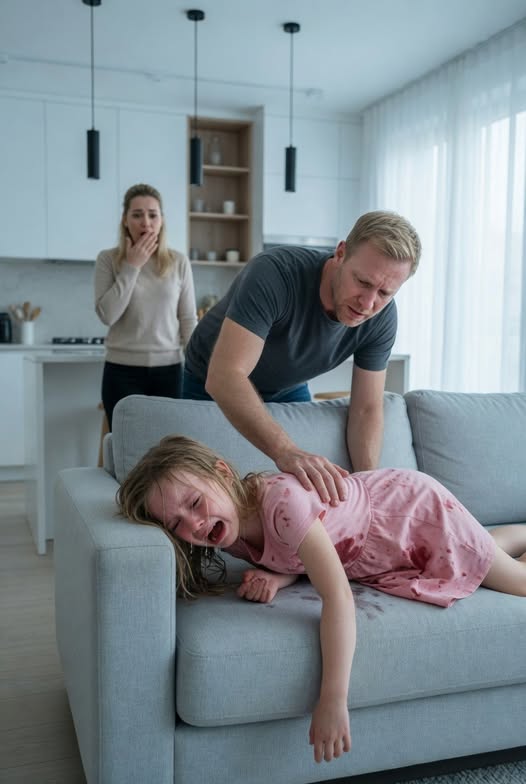
The transition from a peaceful family life to a waking nightmare rarely happens with a loud explosion; usually, it begins with a chilling, quiet realization that the people you trust most are not who they claim to be. For me, that realization arrived on a Tuesday night at exactly 9:04 p.m., triggered by the rustle of a crumpled piece of thermal paper hidden deep within the lining of a pink, glittery suitcase. My seven-year-old daughter, Sofia, had just returned from a fourteen-day stay with her grandmother—a trip that was supposed to be a reprieve of baking cookies and garden play. Instead, she returned as a shadow of herself. When I reached out to ruffle her hair in greeting, she didn’t giggle or lean in; she flinched, her small frame recoiling as if my hand were a hot iron.
That flinch was the first crack in the foundation of my world. As Sofia slept fitfully in her room, I began to unpack her bags, searching for a reason for her sudden, paralyzing anxiety. That was when I found it: a pediatric clinic discharge summary tucked inside a side pocket, buried beneath layers of clothes. As I smoothed the paper out on the kitchen’s granite island, the sterile, clinical language hit me like a physical assault. The notes detailed “significant bruising” and “abrasions across the upper back and shoulders.” But the detail that stopped my heart—the detail that turned my blood to ice—was the signature at the very bottom. It wasn’t the grandmother’s handwriting. It was the elegant, unmistakable script of my wife, Rachel.
Standing in the dimly lit hallway, the clinic paper trembled in my grip. The weight of the betrayal was suffocating. Rachel had known. She had been informed of the injuries, she had authorized the medical examination, and she had intentionally kept it buried under a layer of expensive, polite silence. We had built a life on what I thought was mutual respect and shared values, but the realization hit me with the force of a wrecking ball: my wife had sanctioned the systematic breaking of our daughter’s spirit. The woman I shared a bed with had looked at our child’s pain and decided that keeping a family secret was more important than protecting a life.
I didn’t storm into the living room. I didn’t scream. The anger was too cold and too deep for noise. I walked back into the kitchen, placed the document flat on the island, and simply waited. When Rachel eventually walked in, her face was a mask of practiced, ivory-tower indifference. She saw the paper. She saw the accusation written across my face. For a long moment, the only sound in the room was the hum of the refrigerator. The air grew heavy, thick with the scent of a dying marriage. Rachel didn’t offer an apology or a tearful explanation. Instead, she offered a cold, calculated justification. She spoke of “family legacy,” of “correcting behavioral lapses,” and the necessity of “matured composure.” Her voice was as sharp and detached as a surgeon’s scalpel. In that moment, the woman I had loved for a decade vanished, replaced by a terrifying stranger who viewed our daughter as a project to be polished and disciplined into submission rather than a human being to be nurtured and loved.
I realized then that there was no middle ground. You cannot compromise with someone who justifies the abuse of a child in the name of tradition or decorum. I didn’t wait for the sun to rise to make my move. While Rachel retreated into her cold silence, I went upstairs and woke Sofia gently. She didn’t ask questions when I told her we were leaving; she simply held my hand with a grip so tight it told me everything I needed to know about the terror she had been carrying. We left the house that night, leaving behind the expensive furniture and the hollow “perfect” life that had become a prison for my little girl.
By 9:00 a.m. the next morning, I wasn’t arguing with my wife or negotiating through lawyers. I was sitting in a sterile, brightly lit government office, watching a child safety investigator read those clinic notes aloud. The investigator’s face remained professional and neutral, but the way her pen moved across the notepad—with a sharp, definitive purpose—signaled the official end of my old life. Reporting the woman I loved was the hardest thing I have ever done, but watching Sofia’s face as she realized she was finally safe made the choice effortless.
The fallout from that day was absolute and scorched-earth. The polite dinners with the extended family ceased to exist. The “different standards” of parenting that Rachel had tried to use as a shield were stripped away by the court. I learned a brutal but vital lesson: dignity and safety are not things you negotiate; they are things you defend with everything you have. The legal battle was grueling, and the social isolation from Rachel’s “legacy-focused” family was intense, but every time I looked at Sofia, the cost seemed like a bargain.
A year has passed since that night in the kitchen. My home is much quieter now, but it is a different kind of silence. It is no longer the heavy, pressurized silence of a child trying to be perfect to avoid a hidden hand. It is the peaceful silence of a home where a seven-year-old is finally learning how to be a child again. I lost my marriage, I lost the “safe” routine of my life, and I lost the comfortable illusion of having a perfect family. But as I stand at the door and watch Sofia run toward me, her laughter ringing out unburdened and free, I know I kept the only thing that actually mattered. She no longer flinches when I reach out to hug her. She knows that in this house, love doesn’t leave bruises, and the truth is never hidden in a suitcase. We are starting over, and while the road to healing is long, we are finally walking it in the light.