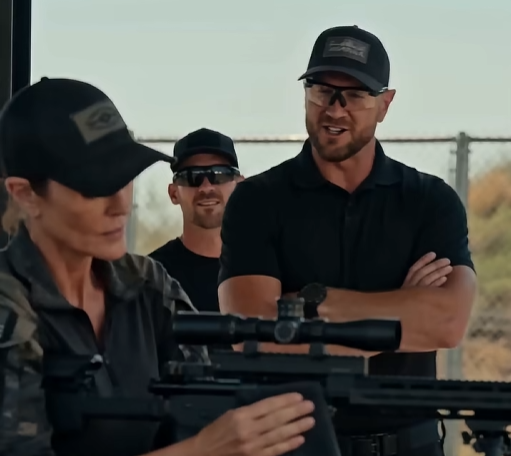
“Step back. Now.”
The water hit her before anyone understood why.
A sharp arc from a metal canteen splashed across her face and the rifle parts resting in her lap. Warm droplets scattered across black steel, dry Arizona dust, and the sleeve of her dark tactical jacket.
The entire firing line paused.
Not because people were shocked.
Because people always paused when someone powerful decided to humiliate someone weaker in public.
They wanted to see how bad it would get.
“Step back. Now.”
Marcus Hale’s voice rolled through the desert range with calm authority.
He didn’t raise it.
He never had to.
The midday sun burned over Blackridge Precision Range, turning the open desert into a sheet of shimmering heat. Dust drifted across the concrete firing lanes. Brass casings glittered under the light like scattered coins. The distant crack of sniper rifles echoed unevenly across the valley, followed seconds later by faint metallic pings from steel targets nearly a kilometer away.
Marcus walked slowly past the shaded shooting stations, expensive tactical sunglasses hiding his eyes. Even in civilian clothes, he carried himself like command staff. Every movement controlled. Every step deliberate.
The shooters around him reacted immediately.
A smirk here.
A quiet laugh there.
One man leaned against a supply crate shaking his head.
Another crossed his arms, waiting for the woman to explode.
Nobody stepped in.
Nobody ever stepped in when Marcus Hale was involved.
Not at Blackridge.
Not at any long-range competition in the country.
Because Marcus wasn’t just famous.
He was a legend.
Former military shooting champion.
Private security consultant.
Television interviews.
Sponsors.
Magazine covers.
The kind of man who entered a room already convinced he owned it.
And most of the time, he was right.
He stopped beside the woman without looking directly at her yet.
“Tell me, sweetheart,” he said casually, “what exactly are you doing on my firing line?”
A few shooters laughed louder.
The woman didn’t answer.
She sat beneath the narrow strip of shade beside the station table, water still sliding slowly down her cheek.
And her hands kept moving.
That was the first strange thing.
Not the silence.
Not the insult.
Her hands.
They never hesitated.
A bolt assembly rested across her lap beside separated rifle components. Black solvent stained the cloth near her knee. Her fingers moved through the mechanism with quiet precision—checking alignment, adjusting tension, cleaning carbon residue from the locking lugs.
Every movement looked practiced.
Not hobby-level practiced.
Not range-day practiced.
Instinctive.
Like breathing.
Marcus noticed it immediately.
His smile faded slightly behind the sunglasses.
Around them, the range stayed alive with motion.
Wind rattled loose metal sheets near the equipment shed.
A diesel generator hummed somewhere behind the berm.
Two younger competitors argued over spotting scopes farther down the line.
Someone chambered a round with a loud metallic snap.
But near her—
Something felt still.
Wrong somehow.
Marcus finally looked down fully.
No sponsor logos.
No competition tags.
No visible credentials.
No patches.
Nothing identifying who she belonged to.
That irritated him more than it should have.
Blackridge wasn’t a public tourist range. Elite shooters trained here. Contractors. Competitive marksmen. Ex-military professionals.
Everyone important wore status on their chest somehow.
Except her.
She simply sat there like she existed outside the hierarchy of the place.
Marcus tilted his head slightly.
“You lost?” he asked.
More laughter.
One of the competitors—a tall former Marine named Carter Vaughn—grinned openly now.
“She probably thought this was the public pistol range.”
Another burst out laughing beside him.
Still—
The woman never reacted.
She picked up the rifle barrel.
Ran the cloth slowly along the metal.
Then calmly attached the receiver.
Click.
Precise.
Clean.
No wasted movement.
Marcus’ jaw tightened slightly.
He had spent most of his life around dangerous people. Soldiers. Contractors. Men who carried violence around like a second skin.
And experience taught him something important.
Real amateurs moved loudly.
Real professionals didn’t.
“Hey,” Carter called out. “You deaf?”
The woman finally stopped moving.
Not dramatically.
Just enough.
Then slowly—
She lifted her eyes.
The atmosphere changed immediately.
Subtle.
But real.
Several shooters unconsciously straightened.
One man lowered the binoculars he’d been holding.
Another stopped smiling without realizing it.
Her eyes were gray.
Cold gray.
Not emotional.
Not angry.
Not embarrassed.
That was the unsettling part.
There was no reaction inside them at all.
She looked at Marcus Hale the way someone looked at weather.
Just another thing existing in front of her.
Marcus felt it instantly.
And hated it.
People usually reacted to him.
Especially under pressure.
Fear.
Respect.
Anger.
Something.
But this woman looked completely untouched by the situation.
Like the humiliation simply hadn’t landed.
Marcus slid his sunglasses slightly lower.
“What’s your rank?” he asked.
Her voice came quietly.
Flat.
Controlled.
“No rank to report.”
The answer triggered another round of laughter.
Carter nearly doubled over.
“Oh, that’s incredible.”
Marcus smiled again, but thinner now.
“Then maybe you’re just here to clean our rifles?”
A few shooters barked out louder laughs.
Someone muttered, “Damn.”
Still—
Nothing.
No anger.
No embarrassment.
The woman simply returned her attention to the rifle in her lap.
Click.
Another component locked into place.
That tiny metallic sound somehow cut through the laughter sharper than shouting would have.
Marcus noticed several people glancing back toward her hands again.
Because now everyone was watching them.
Watching how smoothly she worked.
Watching how naturally she handled the rifle.
Watching how calm she remained while being publicly humiliated.
And slowly—
The mood began shifting.
Not much.
Just enough.
Marcus sensed it immediately.
Control depended on momentum.
And the momentum wasn’t moving where he wanted anymore.
“So answer me properly,” Marcus said, voice harder now. “Why are you here?”
This time she looked at him immediately.
“I’m here to shoot.”
Silence.
Then laughter exploded again across the firing line.
Carter wiped at his face.
“Oh, this keeps getting better.”
Another competitor stepped closer, grinning.
“At what distance?”
The woman didn’t answer right away.
Heat shimmered violently across the desert behind them.
A gust of dry wind rolled through the range carrying the smell of gun oil and hot steel.
Far downrange, a steel target rang faintly.
Ping.
The woman calmly inserted the bolt assembly into the rifle.
CLICK.
The sound felt heavier than it should have.
Marcus watched her hands carefully now.
No shaking.
No hesitation.
No unnecessary movement.
She handled the rifle the way concert pianists touched keys.
Pure familiarity.
The realization irritated him more with every passing second.
Because now he couldn’t stop noticing things.
The expensive custom action.
The balance of the chassis.
The old scratch line near the receiver.
The small mark beneath the bolt handle.
He had missed it before because he had been too busy performing dominance for an audience.
Now he saw it.
And the sight of it went through him like a hand closing around his throat.
That rifle wasn’t just custom.
It was familiar.
Marcus took another step.
“Where did you get that rifle?”
The woman stayed behind the scope.
“Does it matter now?”
Her voice was quiet.
Flat.
But something underneath it had changed.
Not anger.
Not fear.
A wound kept under control.
Marcus swallowed once.
Around them, the firing line remained frozen. The same men who had laughed now stood with their hands at their sides, unsure where to look.
Carter stepped between Marcus and the woman’s line of sight.
“Hey, Hale,” he said. “Don’t tell me you’re actually taking this seriously.”
Marcus did not look at him.
“I asked her a question.”
The woman finally lifted her head from the stock.
Slowly.
Her gray eyes found Marcus.
For a second, the desert range disappeared from his face. The arrogance thinned. The champion, the legend, the man who owned every room he entered—all of it cracked just enough for something older to show through.
Regret.
The woman saw it.
And that made her expression colder.
“It belonged to Daniel Cross,” she said.
The name hit Marcus harder than the desert heat.
No one else reacted immediately. Most of the younger shooters didn’t know the name. Carter did. Darius did.
Marcus did.
Daniel Cross had been a myth before Marcus Hale became one.
A quiet long-range shooter with no sponsorships, no interviews, and no interest in fame. Men like Marcus won trophies. Daniel Cross made impossible shots in places no camera ever reached.
Then, twelve years ago, Daniel disappeared from the sport after a catastrophic failure during an exhibition shot at Blackridge.
The official report said equipment error.
The whisper network said nerves.
Some said Daniel Cross had finally broken under pressure.
Marcus had never believed any of it.
But he had never proved anything.
His voice lowered.
“Who are you?”
The woman’s eyes didn’t move.
“His daughter.”
The words landed softly.
But they changed the shape of everything.
A few shooters exchanged uneasy looks.
Carter looked away too quickly.
Darius Reed reached toward the scoring table and quietly adjusted a camera angle.
Marcus saw the movement.
So did the woman.
For the first time, something almost like pain crossed her face.
“My father said if I ever came here,” she continued, “I should expect people to laugh before they listened.”
Marcus stared at her.
Daniel Cross had a daughter.
He hadn’t known.
Or maybe he had refused to know.
Memory came back in pieces now.
Daniel standing under this same Arizona sun.
Daniel wiping dust from the same rifle.
Daniel saying quietly, “The shot isn’t the hard part, Hale. The hard part is staying still when everyone wants you to move.”
Marcus had laughed at him then.
He had been younger.
Louder.
Hungrier.
He had thought silence was weakness because he had not yet learned how loud guilt could become.
Carter cleared his throat.
“Well,” he said, forcing a grin back onto his face, “that’s touching. But family history doesn’t hit steel.”
The woman turned her eyes toward him.
“No,” she said. “It doesn’t.”
Then she looked back through the optic.
“But sabotage does miss differently.”
The word froze the air.
Sabotage.
No one laughed.
Carter’s face changed so quickly Marcus almost missed it. A flicker. Less than a second. But enough.
Darius Reed stopped pretending to adjust the target camera.
Marcus turned toward Carter.
“What did she say?”
Carter scoffed.
“Oh, come on. This is ridiculous.”
The woman kept her cheek on the stock.
“The wind isn’t the problem,” she said.
Her voice remained calm, but every person on the line leaned slightly closer.
“The mirage isn’t the problem.”
Her finger stayed beside the trigger.
“The round is.”
Marcus looked down at the magazine she had loaded.
Carter’s eyes followed.
The woman continued.
“The third cartridge from the top has a shaved neck and a compressed shoulder. It would chamber rough, throw pressure wrong, and miss low left if it didn’t split first.”
The firing line went dead silent.
Marcus’ stare moved from the rifle to Carter.
Carter laughed once.
Too loud.
“That’s insane. She hasn’t even fired.”
“No,” the woman said. “But someone expected me to.”
Darius finally spoke.
“She’s right.”
All eyes snapped toward him.
The range official looked older suddenly. His face had gone pale beneath the brim of his cap.
“I checked the prep bench after she sat down,” Darius said. “One of the ammo boxes had been opened.”
Carter pointed at him.
“You’re seriously backing this?”
Darius didn’t blink.
“I’ve been backing it for twelve years.”
That was the second hidden truth.
Marcus turned slowly.
“What does that mean?”
Darius’ throat moved.
He looked at the woman.
Then at Marcus.
Then at the desert beyond the target line, as if the answer were still buried somewhere in the heat.
“I was assistant scorer the day Daniel Cross lost everything,” Darius said. “I saw someone near his ammunition before the shot.”
Carter’s mouth tightened.
Marcus went still.
Darius continued, voice rougher now.
“I was twenty-six. I had a pregnant wife, no money, and a boss who told me if I opened my mouth, I’d never work a range again.” He looked down. “So I stayed quiet.”
The woman didn’t move.
But Marcus saw her hand tighten once beneath the rifle.
Only once.
The first real crack in her control.
Darius looked at her with shame in his eyes.
“I’m sorry, Lena.”
Now they had her name.
Lena Cross.
The woman who had sat under the shade and let water run down her face because there were worse things than humiliation.
Because she had come here for something older.
Marcus looked at Carter.
“You were there.”
Carter’s expression hardened.
“So were you.”
The words struck.
Marcus said nothing.
Carter smiled now, but it was ugly.
“You all loved Daniel Cross when he was useful. Quiet genius. Miracle shooter. Man of mystery.” He stepped backward slightly, palms opening. “But let’s not pretend the sport wanted him at the top. He wouldn’t sell anything. Wouldn’t shake hands. Wouldn’t play the game.”
Marcus’ voice went low.
“What did you do?”
Carter’s eyes flashed.
“I did what everyone else was too clean to admit needed doing.”
A murmur passed down the line.
Darius whispered, “God.”
Carter pointed toward Lena.
“And now she walks in here with his rifle, his face in her eyes, acting like silence makes her holy?”
Lena lifted her head again.
This time, something did show in her eyes.
Not rage.
Grief disciplined into focus.
“My father never wanted your trophies,” she said.
Carter laughed bitterly.
“No. He wanted to be better than everyone while pretending he didn’t care.”
Marcus stepped toward Carter.
Carter stepped back again.
Two range officials moved subtly closer.
Marcus’ voice was almost unrecognizable now.
“You sabotaged Daniel’s ammunition.”
Carter’s jaw worked.
“He was going to expose half the sponsored shooters on this circuit for using illegal load modifications. You know what would’ve happened? Blackridge would’ve collapsed. Sponsors gone. Careers gone.” His eyes cut to Marcus. “Including yours.”
Marcus flinched.
Not visibly enough for most people.
But Lena saw it.
Carter saw it too.
“That’s right,” Carter said. “You didn’t know how deep it went, did you? But you knew enough to stay quiet after.”
Marcus’ face tightened with a different kind of pain.
The accusation had weight because it wasn’t entirely false.
He had not sabotaged Daniel.
But after Daniel’s disgrace, Marcus had benefited from the silence.
He had signed the sponsors.
Taken the interviews.
Accepted the trophies that came easier once Daniel Cross was gone.
And when doubt whispered at the edge of his conscience, Marcus had buried it beneath applause.
Lena’s voice cut through him.
“My father knew you didn’t do it.”
Marcus looked at her.
The words seemed to hurt him more than blame would have.
Lena reached into the small pouch beside her knee and pulled out a folded piece of paper, sealed in plastic, old and creased. She did not hand it to him yet.
“He wrote your name in his notes,” she said. “Not as the man who ruined him.”
A beat.
“As the only one who might someday have enough power to fix it.”
Marcus couldn’t speak.
The desert wind moved dust between them.
For once, Marcus Hale looked like a man without a script.
Carter seized the pause.
“This is theater,” he snapped. “All of it. A sad little daughter showing up with a ghost story and a rifle she probably can’t even zero.”
Lena looked at him.
Then at Marcus.
“I didn’t come to argue.”
She placed the old note on the shooting table.
“I came to repeat the shot.”
Darius closed his eyes briefly.
Marcus stared at her.
“No.”
It came out instantly.
Too emotional.
Too human.
Lena’s face remained steady.
“Yes.”
Marcus stepped closer.
“You don’t have to do this.”
That made several shooters glance at one another.
The same Marcus Hale who had thrown water in her face minutes earlier now sounded almost desperate.
Lena’s mouth tightened.
“You made sure I did.”
The words landed between them with cruel accuracy.
Marcus absorbed them.
Then nodded once, slowly.
“You’re right.”
That shocked the line more than anything else had.
Marcus Hale did not apologize in public.
Marcus Hale did not concede.
But the man standing there now was no longer performing for the range.
He removed his sunglasses.
His eyes were tired.
Older than his face.
“When I saw the rifle,” he said quietly, “I thought if I pushed hard enough, whoever came here to stop you would show themselves.”
Lena’s expression shifted.
Just slightly.
“You knew?”
“I suspected.” Marcus looked toward Carter. “Not him at first. But I knew someone would move if Daniel Cross’s rifle appeared on my line again.”
Carter’s face darkened.
Marcus looked back at Lena.
“The water was wrong. The words were wrong. I thought I could control the room without telling you why.” His voice thickened. “I was arrogant enough to think hurting you a little in public was acceptable if it exposed the truth.”
Lena stared at him.
No forgiveness.
Not yet.
Maybe not ever fully.
But something in her eyes changed.
Because now the earlier cruelty had a second meaning.
Not an excuse.
But a deeper wound.
Marcus hadn’t humiliated her because he thought she was weak.
He had done it because he was afraid the real attack would be worse.
And because fear in powerful men often dressed itself as cruelty.
Carter sneered.
“So noble.”
Marcus turned.
“No,” he said. “Cowardly.”
The word silenced everyone.
Marcus looked at Darius.
“Call security.”
Darius nodded.
But Carter moved first.
He lunged toward the shooting table.
Not at Lena.
At the ammunition.
His hand grabbed for the opened box, fingers closing around evidence that had waited twelve years to matter.
Lena moved before anyone else.
Not violently.
Not dramatically.
She simply stepped into his path and struck his wrist aside with the back of her forearm. The ammo box hit the ground, scattering rounds across dust and concrete.
Carter stumbled.
Two range officials grabbed him immediately.
He shouted, twisted, cursed.
“Get off me!”
Marcus did not move to help him.
Carter’s eyes burned with panic now.
“You think this fixes anything?” he shouted at Lena. “You think one shot brings your father back?”
Lena’s face tightened.
For a second, the control almost failed.
Almost.
Then she bent down, picked up one clean cartridge from her own sealed pouch, and held it between two fingers.
“No,” she said softly. “But it lets him stop falling.”
That broke something in the crowd.
Not loudly.
Not visibly.
But men who had laughed earlier now looked away in shame.
Darius wiped at his mouth with the back of his hand.
Marcus lowered his eyes.
The range seemed impossibly quiet.
Eight hundred meters away, the steel target waited in the heat.
Lena loaded the clean cartridge.
One round.
No magazine.
No second chance.
Marcus stepped beside her.
Not too close.
“Do you want a spotter?”
She looked at him.
The question carried more than ballistics.
Do you want help?
Do you want witness?
Do you want me to stand where I should have stood twelve years ago?
Lena studied him for a long moment.
Then she looked toward Darius.
“Record everything.”
Darius nodded quickly.
“Already rolling.”
Marcus accepted that answer.
He stepped back.
Lena settled behind the rifle again.
This time, no one spoke.
Not Carter, restrained near the scoring table.
Not Marcus.
Not Darius.
Not the shooters who had mocked her.
The wind dragged dust sideways.
Mirage bent the target until it seemed to breathe.
Lena adjusted the scope by feel.
One click.
Then another.
Marcus watched.
He knew enough to see she was not guessing.
Her father had taught her.
Or perhaps grief had.
Through the optic, Lena saw the steel target wavering like a memory that did not want to be held.
For years, she had imagined this moment as clean.
She would arrive.
Expose the truth.
Make the shot.
Clear her father’s name.
But reality was messier.
Her hands remembered Daniel Cross, but her chest remembered every night he sat silent at the kitchen table after losing everything. Every time he smiled at her school competitions but never stepped near a rifle again. Every time he told her, “Some truths arrive late, sweetheart. Don’t let that make you cruel.”
He had died without seeing his name repaired.
That was the part that hurt most.
Not the lost trophies.
Not the public shame.
The waiting.
The fact that good people could spend years carrying a truth no one wanted to hear.
Her breathing changed.
Marcus noticed.
So did Darius.
Carter watched too, suddenly quiet.
For the first time, he seemed afraid—not of being caught, but of being proven small.
Lena closed her eyes briefly.
Her father’s voice came back, not as thunder, but as memory.
The shot isn’t the hard part.
She opened her eyes.
The hard part is staying still when everyone wants you to move.
Her finger touched the trigger.
The world narrowed.
Wind.
Heat.
Distance.
Heart.
Steel.
She exhaled.
The rifle fired.
The sound cracked across the desert, sharp and absolute.
Everyone waited.
At eight hundred meters, even sound needed time to return.
One second.
Two.
Three.
Then—
Ping.
Clean.
Centered.
The target camera monitor flashed.
Darius looked down.
His lips parted.
“Dead center,” he whispered.
No one cheered at first.
The moment was too heavy for cheering.
Then one shooter removed his cap.
Another followed.
A third lowered his head.
Marcus stared at the monitor.
At the tiny bright mark in the center of the steel plate.
Twelve years of silence reduced to a single honest sound.
Ping.
Carter sagged between the officials holding him.
His face had gone gray.
Darius turned the monitor toward the line.
“Impact confirmed,” he said, louder now. “Eight hundred meters. Clean ammunition. Clean shot.”
A murmur spread.
Not excitement.
Recognition.
The kind that arrives when people realize they have been part of something shameful and can no longer pretend they were only watching.
Marcus walked to the table.
Picked up Daniel Cross’s old note.
His fingers trembled slightly as he read it.
Lena stood but did not approach him.
Marcus read silently at first.
Then his throat tightened.
“Read it,” Lena said.
Marcus looked at her.
She nodded once.
So he did.
His voice was rough.
“If this ever reaches Blackridge, don’t let my daughter inherit my silence. She deserves the truth, but not my bitterness. If Hale is still there, make him choose better than we did.”
Marcus stopped.
The wind moved across the range.
No one breathed loudly.
Lena’s face finally changed.
Not breaking.
But softening around the edges, as if the words had touched a part of her she had armored too long.
Marcus folded the note with care.
Then he turned toward the shooters, the officials, the cameras, and Carter Vaughn.
“My name is Marcus Hale,” he said. “And twelve years ago, I failed Daniel Cross.”
The sentence stunned the range.
Marcus continued before pride could stop him.
“I did not sabotage him. But I benefited from the silence after someone did. I accepted titles, money, and respect while doubt sat in front of me.” His eyes moved to Lena. “Today, his daughter did what I should have done years ago.”
Carter shouted, “You’re destroying yourself for this?”
Marcus looked at him calmly.
“No,” he said. “I’m finally telling the truth before it destroys anyone else.”
Darius stepped forward.
“I have the old footage,” he said.
Carter’s head snapped toward him.
Darius swallowed.
“I kept a copy. I was too scared to use it. But I kept it.”
Marcus stared at him.
Lena did too.
Darius’ eyes filled with tears he refused to let fall.
“I thought keeping it made me less of a coward.” His voice cracked. “It didn’t.”
Lena was silent for a long moment.
Then she said, “Use it now.”
Darius nodded.
“I will.”
Security arrived minutes later.
Carter fought until he realized no one was coming to defend him.
Not the sponsors.
Not the officials.
Not Marcus.
He was led past Lena with dust on his boots and fear in his mouth.
He looked at her as if he wanted to say something final, something cutting.
But there was nothing left.
She had not beaten him with rage.
That was what made it worse.
She had beaten him with patience.
With evidence.
With the shot he had spent twelve years trying to erase.
When Carter was gone, the range did not return to normal.
It couldn’t.
Some silences end.
Others change shape.
The shooters who had laughed earlier stood scattered in the heat, embarrassed by their own hands, their own mouths, their own ease in joining cruelty.
One of them, a young competitor barely older than twenty-five, approached Lena first.
He stopped a few feet away.
“I laughed,” he said.
Lena looked at him.
He swallowed.
“I’m sorry.”
She studied him for a moment.
Then nodded once.
Not warmly.
But honestly.
That was enough.
Others followed.
Not all at once.
Not dramatically.
A quiet line formed without anyone announcing it.
Apologies came awkwardly, imperfectly.
Some too short.
Some too late.
Some more about their shame than her pain.
But Lena accepted them with the same calm she had carried through the humiliation.
Not because she owed forgiveness.
Because she refused to let their failure define the rest of the day.
Marcus waited until the others were gone.
The sun had shifted lower by then, softening the brutal white light into something warmer. The steel targets still hung in the distance. Dust settled slowly over the scattered brass.
Lena stood by the shooting table, packing the rifle.
Her father’s rifle.
Marcus approached slowly.
This time, he did not command space.
He asked permission with his distance.
“Lena.”
She didn’t look up.
“Yes.”
“I can reopen the record publicly. With Darius’ footage, the ammunition evidence, today’s recording, and my statement.” He paused. “Your father’s name will be cleared.”
Her fingers stopped on the rifle case.
For years, she had imagined that sentence.
She had thought it would feel like victory.
Instead, it felt like grief finally finding a door.
She nodded.
“Good.”
Marcus looked down.
“It won’t fix what happened.”
“No.”
“It won’t give him back the years.”
“No.”
He accepted each answer like he deserved it.
Then he said, “I’m sorry.”
Lena closed the rifle case.
The click of the latches sounded small after everything.
She finally faced him.
“Which part?”
Marcus’ eyes tightened.
“All of it.”
That answer mattered.
Because excuses would have been easier.
The water.
The words.
The silence twelve years ago.
The fame.
The cowardice.
All of it.
Lena held his gaze for a long time.
Then she reached into her pocket and pulled out a faded photograph.
Daniel Cross stood in the picture beside a much younger Marcus Hale. Both men were sunburned, dusty, and smiling like they had not yet learned how expensive pride could become.
Marcus took the photo carefully.
His face changed.
Daniel had written something on the back.
Marcus turned it over.
Hale talks too much. But he sees the wind.
A broken laugh escaped Marcus.
It didn’t last.
His eyes shone.
Lena watched him quietly.
“He kept that?” Marcus asked.
“He kept everything,” she said.
Marcus looked at the photo as if it weighed more than the rifle.
“I don’t deserve this.”
“No,” Lena said.
Then, after a beat:
“But he wanted you to have it.”
That was the closest thing to forgiveness she could give.
And Marcus understood it for what it was.
Not absolution.
A responsibility.
He held the photograph with both hands.
Darius approached from behind them, carrying a small external drive.
“The footage is here,” he said. “All of it.”
Marcus nodded.
“Send copies to the commission, the sponsors, and every outlet that covered Daniel’s fall.”
Darius looked at Lena.
“With your permission.”
Lena took the drive.
For a moment, her hand closed around it so tightly her knuckles paled.
Then she nodded.
“Do it.”
Darius exhaled shakily.
“I should have done it years ago.”
“Yes,” Lena said.
He flinched, but she wasn’t cruel when she said it.
She simply gave the truth its proper shape.
Then she added, “But you’re doing it now.”
Darius covered his mouth.
His shoulders shook once.
He turned away before the tears fully came.
The desert evening slowly lowered itself over Blackridge.
The heat softened.
The light changed.
The place that had looked harsh and merciless an hour earlier now seemed almost tired.
Reporters would come later.
Statements would be made.
Titles would be questioned.
Carter would face charges.
Marcus would lose sponsors.
Darius would lose years of sleep before he earned any peace.
And Daniel Cross’s name would finally return to the place it had been forced out of.
But for now, none of that had happened yet.
For now, there was only the range.
The wind.
The smell of gun oil.
And one steel target eight hundred meters away with a fresh mark at its center.
Lena carried the rifle case toward the edge of the firing line.
Marcus walked beside her, not leading.
Not commanding.
Just walking.
At the gate, she stopped.
He stopped too.
“Your father was the best shooter I ever knew,” Marcus said.
Lena looked toward the desert.
“No,” she said softly.
Marcus waited.
A faint, tired smile touched her face for the first time.
“He was the best teacher.”
Marcus looked away.
Because that hurt more.
Lena adjusted the strap on the rifle case.
Then she looked back at the range one last time.
The place had taken something from her father.
Today, it had given something back.
Not everything.
Never everything.
But enough for the silence to change.
Enough for a dead man’s name to stand upright again.
Marcus held the old photograph against his chest.
Lena saw it.
And this time, she didn’t look away.
She simply nodded once.
Then she walked into the cooling desert light, carrying her father’s rifle like it was no longer evidence.
Like it was memory.
Behind her, eight hundred meters away, the steel target moved gently in the wind.
And for the first time in twelve years, nobody on the range laughed.